Real-Time Systems: Determinism, Jitter, and the Physics of Zero-Delay Computing
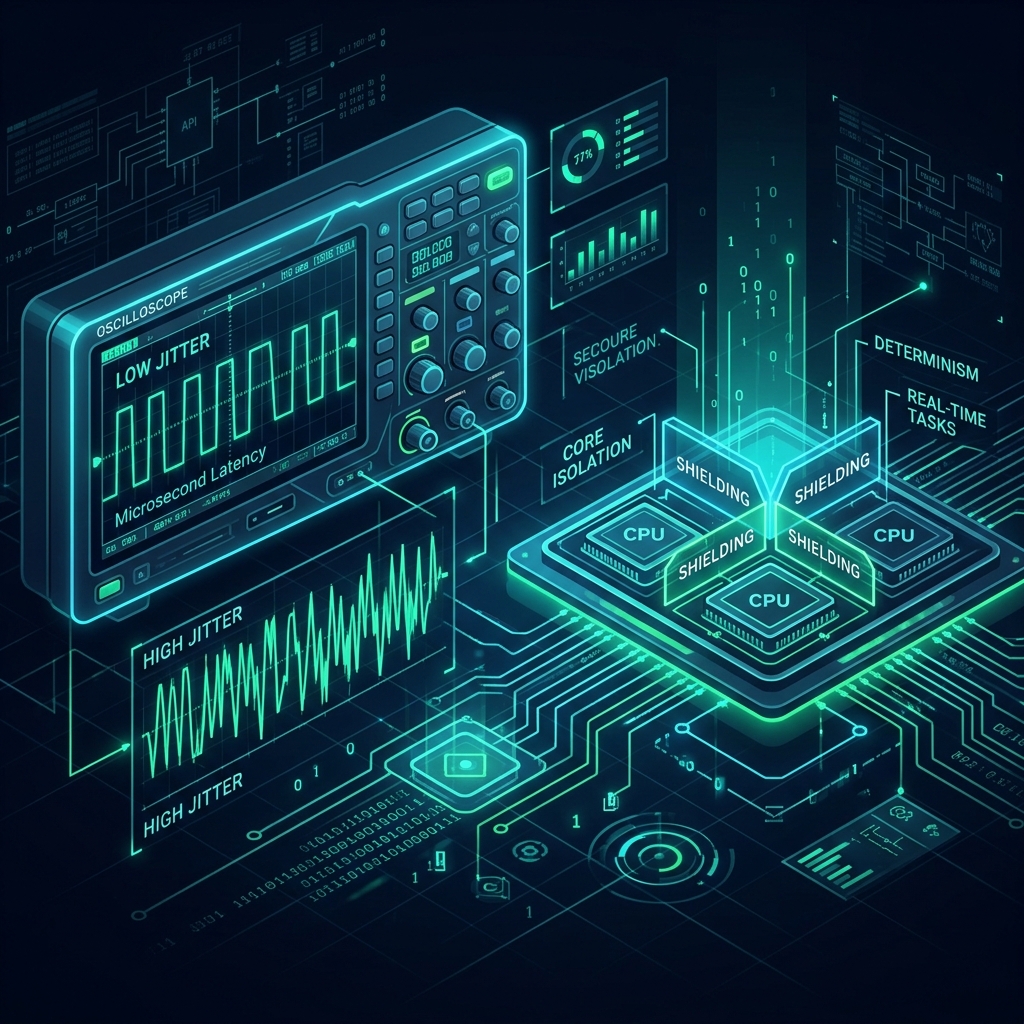
Most software we interact with daily is engineered around convenience, developer productivity, and aggregate throughput. When a web browser pauses for 200 milliseconds to render a dynamic UI component, or a desktop text editor drops a frame during heavy syntax processing, the user experience degrades slightly, but the system continues to operate within acceptable parameters. The computation remains fundamentally correct, even if its delivery is delayed.
In a Real-Time System (RTS), however, timeliness is an explicit, non-negotiable metric of correctness. An answer delivered after its designated deadline is not merely late—it is functionally wrong, and in critical environments, potentially catastrophic.
Whether controlling the flight surfaces of an aircraft, regulating output parameters in a nuclear reactor, or executing microsecond trades in financial markets, real-time computing shifts the primary engineering goal from how much computation can be completed on average to guaranteeing maximum latency bounds under worst-case physical conditions.
The Time-Critical Pipeline Architecture
Unlike general-purpose software running in virtualized abstraction layers, real-time software operates in tight physical coupling with hardware sensors, memory controllers, and physical actuators. The lifecycle of a real-time command follows a deterministic pipeline where every processing stage must be quantitatively bounded.
1
2
3
4
5
6
7
8
+-----------------------------------------------------------------------+
|                         TIME-CRITICAL PIPELINE                        |
+-----------------------------------------------------------------------+
|  [Sensor Event] ---> [Interrupt Latency] ---> [Deterministic Task]   |
|                                                     |                 |
|                                                     v                 |
|  [Actuator Response] <--- [Controlled Jitter] <--- [Execution Bounds] |
+-----------------------------------------------------------------------+
When an external event occurs in the physical world (such as a pressure sensor threshold breach), hardware signals trigger an interrupt signal at the CPU interrupt controller. The system transitions through a tightly controlled chain:
- Hardware Detection & Signal Propagation: The physical sensor asserts an Interrupt Request (IRQ) line.
- Interrupt Latency: The duration between IRQ line assertion and the execution of the first instruction within the corresponding Interrupt Service Routine (ISR).
- Task Scheduling & Context Switch: The Operating System dispatches the target real-time handling thread based on strict priority ordering.
- Bounded Task Execution: The thread processes input data and calculates control outputs without encountering unconstrained locks or allocation stalls.
- Actuator Output & Jitter Mitigation: The computed command is transmitted to physical hardware outputs with tight timing variance.
Core Mechanics: Timeliness, Jitter, and WCET
To maintain stable closed-loop control over physical processes, real-time software engineers must model and measure three foundational metrics:
1
2
3
4
5
6
7
8
9
10
11
12
13
14
+-----------------------------------------------------------------------+
|                       CORE TIMING METRICS                             |
+-----------------------------------------------------------------------+
| Metric                 | Operational Definition                       |
+------------------------+----------------------------------------------+
| Interrupt Latency      | Time from hardware IRQ assertion to initial  |
|                        | ISR instruction execution.                   |
|------------------------+----------------------------------------------|
| Jitter                 | Timing variance across execution cycles:     |
|                        | Δt = |t_actual - t_expected|                 |
|------------------------+----------------------------------------------|
| WCET                   | Maximum upper-bound execution time under     |
|                        | worst-case hardware cache/bus contention.    |
+-----------------------------------------------------------------------+
1. Interrupt Latency
Interrupt latency encompasses both hardware overhead (pin synchronization, interrupt controller propagation) and software overhead (disabling interrupts in non-preemptible kernel sections, context register saving). In standard Linux kernels, disabling interrupts during spinlock acquisition can balloon interrupt latency into milliseconds—an eternity for microsecond-scale control loops.
2. Timing Jitter ($\Delta t$)
Jitter represents the variability or standard deviation in cycle execution times. In digital signal processing and physical feedback loops (such as Proportional-Integral-Derivative / PID controllers), high jitter causes phase shift, noise amplification, and mechanical instability.
\[\Delta t = |t_{\text{actual}} - t_{\text{expected}}|\]Even if a control task completes within its deadline on average, high jitter degrades controller stability. A low average latency with low jitter is far superior to a faster average latency with unpredictable spikes.
3. Worst-Case Execution Time (WCET)
While general-purpose performance optimization targets Average-Case Execution Time (ACET), real-time verification requires computing the Worst-Case Execution Time (WCET). Calculating WCET involves static program analysis, instruction cache warm/cold analysis, branch target predictability, and hardware memory bus contention modeling under maximum system load.
The Criticality Spectrum: Hard, Firm, and Soft Real-Time
Not all timing deadlines carry identical failure consequences. Systems are partitioned into three distinct operational domains based on the severity of a missed deadline:
1
2
3
4
5
6
7
8
9
10
11
12
+-----------------------------------------------------------------------+
|                          DEADLINE CLASSIFICATIONS                     |
+-----------------------------------------------------------------------+
|   HARD         | Zero tolerance. Deadline failure causes total        |
|                | system catastrophe (e.g., Pacemakers, Avionics).     |
|----------------+------------------------------------------------------|
|   FIRM         | Infrequent misses tolerable; late results are        |
|                | discardable garbage (e.g., Financial Trading, GPS).   |
|----------------+------------------------------------------------------|
|   SOFT         | Late results retain value; system performance        |
|                | gracefully degrades (e.g., Video Streaming, Gaming). |
+-----------------------------------------------------------------------+
Hard Real-Time
In a hard real-time system, missing a single deadline results in total system failure, physical damage, or loss of life.
- Examples: Automotive brake-by-wire modules, cardiac pacemakers, missile guidance computers, flight control surface controllers.
- Guarantee Standard: Proof of deterministic WCET compliance under maximum stress.
Firm Real-Time
In firm real-time systems, missing a deadline does not cause catastrophic physical destruction, but the computation delivered past the deadline loses all functional value and must be discarded immediately.
- Examples: Automated high-frequency algorithmic trading systems, satellite GPS telemetry parsing, industrial automated optical inspection (AOI).
- Guarantee Standard: Extremely low statistical probability of deadline failure (e.g., $99.999\%$ deadline satisfaction).
Soft Real-Time
In soft real-time systems, meeting deadlines is desirable for user quality of experience, but late results retain residual utility. Late execution leads to a gradual, graceful degradation of service quality rather than functional invalidity.
- Examples: Video playback buffer rendering, VoIP audio packet processing, interactive video game physics loops.
- Guarantee Standard: Statistical distribution optimization for smooth average delivery.
RTOS Architecture vs. General-Purpose Linux
A standard General-Purpose Operating System (GPOS), such as stock Ubuntu Linux or Windows, prioritizes total throughput, resource utilization fairness, and overall interactive responsiveness. To achieve high throughput, GPOS kernels employ dynamic CPU time-slicing, speculative memory paging, background garbage cleanup, and coarse-grained locking.
Conversely, a Real-Time Operating System (RTOS) sacrifices maximum overall throughput to enforce absolute priority preemption and microsecond-level timing predictability.
| Operational Vector | General-Purpose OS (Standard Linux) | Real-Time OS / PREEMPT_RT Linux |
|---|---|---|
| Primary Goal | High overall throughput, task fairness | Bounded response latency, determinism |
| Scheduling Algorithm | Completely Fair Scheduler (CFS) | Strict Priority Preemptive (SCHED_FIFO / SCHED_RR) |
| Interrupt Response | Unbounded due to kernel locks/spinlocks | Fully preemptible kernel threads |
| Resource Allocation | Dynamic, optimized for average load | Static / Shielded core allocations |
| Jitter Profile | Variable (milliseconds) | Low variance (microseconds) |
| Memory Management | Demand paging, swap space, copy-on-write | Locked physical memory (mlockall), pre-faulted stack |
Deterministic Kernel Architectures
Achieving deterministic kernel execution typically relies on one of two structural paradigms:
1. Dual-Kernel Architecture (e.g., Xenomai, RTLinux)
A lightweight microkernel sits directly on top of the bare-metal hardware. The real-time microkernel handles all high-priority IRQs and time-sensitive tasks. The general-purpose Linux kernel runs as the lowest-priority idle task inside the microkernel framework.
1
2
3
4
5
6
7
8
9
10
+---------------------------------------------------------------------+
|                     DUAL-KERNEL ARCHITECTURE                        |
+---------------------------------------------------------------------+
|  [ Real-Time Applications ]    [ Standard Linux Applications ]      |
|               |                               |                     |
|               v                               v                     |
|  [ RT Microkernel (Xenomai) ] <---> [ Standard Linux Kernel ]       |
|                                                                     |
| ------------------- BARE-METAL HARDWARE --------------------------- |
+---------------------------------------------------------------------+
2. In-Kernel Preemption (PREEMPT_RT)
Rather than maintaining two distinct kernels, PREEMPT_RT converts standard Linux into a deterministic RTOS by altering kernel locking primitives:
- Converts critical section spinlocks into sleeping, preemptible
rt_mutexstructures. - Converts Interrupt Request (IRQ) handlers into dedicated real-time kernel threads with explicit priorities.
- Enforces deterministic Priority Inheritance protocols to eliminate Priority Inversion.
- Makes kernel code paths pre-emptible almost everywhere.
Low-Level Performance Engineering & Hardware Isolation
Writing real-time software requires optimizing system configuration at the bare-metal hardware boundary. Modern multi-core processors introduce dynamic non-determinism via thermal throttling, branch prediction, dynamic cache eviction, and bus contention. Real-time engineers neutralize these sources of jitter using hardware isolation strategies.
1
2
3
4
5
6
7
8
+---------------------------------------------------------------------+
|                       CPU CORE SHIELDING TOPOLOGY                   |
+---------------------------------------------------------------------+
| [ Core 0 ]  --> General OS Tasks, Background Processes, Interrupts  |
| [ Core 1 ]  --> General OS Tasks, System Logging, Network I/O       |
| [ Core 2 ]  --> ISOLATED / SHIELDED: Real-Time Control Loop Task    |
| [ Core 3 ]  --> ISOLATED / SHIELDED: Real-Time HIL Simulation Task  |
+---------------------------------------------------------------------+
Key Isolation Strategies
- CPU Shielding (
isolcpus/cgroups): Partitioning multi-core processors via boot parameters to isolate target CPU cores entirely from Linux kernel scheduling queues. General tasks never run on shielded cores. - Interrupt Affinity Steering: Modifying
/proc/irq/*/smp_affinitymasks to explicitly bind hardware IRQs to dedicated non-real-time cores (e.g., Core 0 and Core 1). This prevents external network or disk interrupts from preempting critical control loops. - Memory Locking (
mlockall): Locking process virtual address space into physical RAM to disable page faulting, swapping, and dynamic virtual page allocation during execution. - NUMA-Aware Core Allocation: Pinning real-time threads and memory allocations strictly to the local NUMA (Non-Uniform Memory Access) node connected directly to the CPU socket, eliminating cross-socket interconnect bus latency.
Low-Level Code Snippets for Real-Time Execution
Below are real-world POSIX C and C++ design patterns required for deterministic execution under Linux PREEMPT_RT.
Snippet 1: POSIX Real-Time Thread Configuration (C)
This snippet demonstrates how to pin a thread to an isolated CPU core, elevate scheduling priority to POSIX SCHED_FIFO, lock memory against page faults, and pre-fault the execution stack.
1
2
3
4
5
6
7
8
9
10
11
12
13
14
15
16
17
18
19
20
21
22
23
24
25
26
27
28
29
30
31
32
33
34
35
36
37
38
39
40
41
42
43
44
45
46
47
48
49
50
51
52
53
54
55
56
57
58
59
60
61
62
63
64
65
66
67
68
69
70
71
72
73
74
75
76
77
78
79
80
81
82
83
#define _GNU_SOURCE
#include <stdio.h>
#include <stdlib.h>
#include <string.h>
#include <pthread.h>
#include <sched.h>
#include <sys/mman.h>
#include <unistd.h>
#define TARGET_CPU_CORE 2
#define RT_PRIORITY 80 // High SCHED_FIFO priority (1-99)
#define STACK_PREFAULT_BYTES (8 * 1024 * 1024) // 8 MB
void prefault_stack(void) {
unsigned char stack[STACK_PREFAULT_BYTES];
// Force physical memory page allocation for stack
memset(stack, 0, STACK_PREFAULT_BYTES);
}
void* realtime_control_loop(void* arg) {
// 1. Lock memory to eliminate page faults
if (mlockall(MCL_CURRENT | MCL_FUTURE) == -1) {
perror("mlockall failed");
exit(EXIT_FAILURE);
}
// 2. Pre-fault stack memory
prefault_stack();
printf("[RT CORE] Real-Time Thread successfully initialized on Core %d\n", TARGET_CPU_CORE);
struct timespec next_period;
clock_gettime(CLOCK_MONOTONIC, &next_period);
// Deterministic 1kHz (1ms) periodic loop
const long PERIOD_NS = 1000000;
for (int i = 0; i < 1000; i++) {
// Execute deterministic computation here (No malloc/free allowed!)
// Calculate next absolute deadline
next_period.tv_nsec += PERIOD_NS;
if (next_period.tv_nsec >= 1000000000) {
next_period.tv_nsec -= 1000000000;
next_period.tv_sec += 1;
}
// Sleep strictly until next absolute MONOTONIC clock deadline
clock_nanosleep(CLOCK_MONOTONIC, TIMER_ABSTIME, &next_period, NULL);
}
return NULL;
}
int main(void) {
pthread_t thread;
pthread_attr_t attr;
pthread_attr_init(&attr);
// Set scheduling policy to SCHED_FIFO (Real-Time Preemptive)
pthread_attr_setschedpolicy(&attr, SCHED_FIFO);
struct sched_param param;
param.sched_priority = RT_PRIORITY;
pthread_attr_setschedparam(&attr, ¶m);
pthread_attr_setinheritsched(&attr, PTHREAD_EXPLICIT_SCHED);
// Set CPU affinity to isolate thread to Core 2
cpu_set_t cpuset;
CPU_ZERO(&cpuset);
CPU_SET(TARGET_CPU_CORE, &cpuset);
pthread_attr_setaffinity_np(&attr, sizeof(cpu_set_t), &cpuset);
if (pthread_create(&thread, &attr, realtime_control_loop, NULL) != 0) {
perror("pthread_create failed");
return EXIT_FAILURE;
}
pthread_join(thread, NULL);
pthread_attr_destroy(&attr);
return EXIT_SUCCESS;
}
Snippet 2: Lock-Free Static Ring Buffer for Zero-Allocation IPC (C++)
Dynamic memory allocation (malloc, new, std::vector::push_back) causes non-deterministic heap lock contention and potential garbage collection delays. Real-Time IPC between control threads uses lock-free, statically allocated ring buffers.
1
2
3
4
5
6
7
8
9
10
11
12
13
14
15
16
17
18
19
20
21
22
23
24
25
26
27
28
29
30
31
32
33
34
35
36
37
38
39
40
41
42
43
44
45
46
47
48
49
50
51
52
53
54
55
56
57
58
59
60
61
62
63
64
65
66
67
68
#include <iostream>
#include <array>
#include <atomic>
#include <cstdint>

template <typename T, std::size_t Capacity>
class LockFreeRingBuffer {
    static_assert((Capacity & (Capacity - 1)) == 0, "Capacity must be a power of 2");

public:
    LockFreeRingBuffer() : head_(0), tail_(0) {}

    // Lock-free push (Single Producer)
    bool push(const T& item) noexcept {
        const auto current_tail = tail_.load(std::memory_order_relaxed);
        const auto current_head = head_.load(std::memory_order_acquire);

        if ((current_tail - current_head) == Capacity) {
            return false; // Buffer full: Jitter-safe drop or flag overrun
        }

        buffer_[current_tail & (Capacity - 1)] = item;
        tail_.store(current_tail + 1, std::memory_order_release);
        return true;
    }

    // Lock-free pop (Single Consumer)
    bool pop(T& item) noexcept {
        const auto current_head = head_.load(std::memory_order_relaxed);
        const auto current_tail = tail_.load(std::memory_order_acquire);

        if (current_head == current_tail) {
            return false; // Buffer empty
        }

        item = buffer_[current_head & (Capacity - 1)];
        head_.store(current_head + 1, std::memory_order_release);
        return true;
    }

private:
    alignas(64) std::array<T, Capacity> buffer_; // Cacheline aligned
    alignas(64) std::atomic<std::size_t> head_;
    alignas(64) std::atomic<std::size_t> tail_;
};

struct SensorTelemetry {
    uint64_t timestamp_ns;
    float pressure_psi;
    float temperature_c;
};

int main() {
    // 1024-entry ring buffer initialized statically on stack/BSS
    LockFreeRingBuffer<SensorTelemetry, 1024> telemetry_queue;

    SensorTelemetry data{1717000000000ULL, 14.7f, 22.5f};
    if (telemetry_queue.push(data)) {
        std::cout << "[IPC] Telemetry successfully queued without mutex or heap allocation!" << std::endl;
    }

    SensorTelemetry read_data;
    if (telemetry_queue.pop(read_data)) {
        std::cout << "[IPC] Telemetry popped: " << read_data.pressure_psi << " PSI" << std::endl;
    }

    return 0;
}
Snippet 3: POSIX Priority Inheritance Mutex (PTHREAD_PRIO_INHERIT)
Priority inversion occurs when a low-priority thread holding a mutex is preempted by a medium-priority thread, indirectly stalling a high-priority thread waiting on that mutex. Enabling Priority Inheritance resolves this by temporarily boosting the low-priority thread’s priority to match the blocked high-priority thread.
1
2
3
4
5
6
7
8
9
10
11
12
13
14
15
16
17
18
19
20
21
22
23
24
#include <pthread.h>
#include <stdio.h>
#include <stdlib.h>

pthread_mutex_t create_priority_inheritance_mutex(void) {
    pthread_mutex_t mutex;
    pthread_mutexattr_t attr;

    pthread_mutexattr_init(&attr);

    // Enforce Priority Inheritance Protocol
    if (pthread_mutexattr_setprotocol(&attr, PTHREAD_PRIO_INHERIT) != 0) {
        perror("Failed to set PTHREAD_PRIO_INHERIT");
        exit(EXIT_FAILURE);
    }

    if (pthread_mutex_init(&mutex, &attr) != 0) {
        perror("Failed to initialize priority inheritance mutex");
        exit(EXIT_FAILURE);
    }

    pthread_mutexattr_destroy(&attr);
    return mutex;
}
Simulation and Hardware-in-the-Loop (HIL) Validation
Because real-time software controls high-risk physical machinery (e.g., flight actuators, power grids, autonomous vehicles), executing unvalidated software on physical hardware carries high operational risk and expense.
To bridge this gap, hardware validation teams build Hardware-in-the-Loop (HIL) test environments.
1
2
3
4
5
6
7
8
9
+---------------------------------------------------------------------+
|                     CLOSED-LOOP HIL TESTBENCH                       |
+---------------------------------------------------------------------+
|  +--------------------+   Actuator Signals  +--------------------+  |
|  | Physical Controller| ------------------->| Real-Time HIL      |  |
|  | Under Test (ECU)   |                     | Simulator          |  |
|  |                    | <-------------------| (Emulated Physics) |  |
|  +--------------------+    Sensor Emulation +--------------------+  |
+---------------------------------------------------------------------+
In a HIL simulation testbench:
- The Electronic Control Unit (ECU) running the target real-time binary connects to high-speed IO interface boards.
- The Real-Time HIL Simulator executes mathematical physics models (e.g., aerodynamic lift, engine thermodynamics) on real-time platforms such as RedHawk Linux or FPGA arrays.
- Sensor signals are emulated in hardware with sub-microsecond precision, providing realistic closed-loop physical feedback to the ECU.
Why Real-Time Systems Fail Late in Development
Real-time software projects often fail late in integration testing due to subtle, non-reproducible timing bugs:
1
2
3
4
5
6
7
8
9
10
11
12
13
14
+-----------------------------------------------------------------------+
|                    COMMON LATE-STAGE FAILURE MODES                    |
+-----------------------------------------------------------------------+
| Failure Cause               | Root Mechanism                          |
+-----------------------------+-----------------------------------------+
| Unbounded Latency Spikes    | Unexpected kernel spinlocks or hardware |
|                             | interrupt storms.                       |
|-----------------------------+-----------------------------------------|
| Unprotected Priority        | Low-priority task blocked by medium     |
| Inversion                   | task, stalling high-priority control.   |
|-----------------------------+-----------------------------------------|
| Clock Drift & Synchronization | Distributed nodes drifting without      |
|                             | IEEE 1588 PTP / TSN hardware clocks.    |
+-----------------------------------------------------------------------+
1. Unbounded Latency Spikes
Subtle timing bugs caused by unexpected interrupt nesting, unhandled device driver lock contention, or un-shielded background kernel maintenance tasks (such as memory compaction or journal flushing).
2. Unprotected Priority Inversion
A high-priority task gets blocked waiting for a low-priority task that holds a shared resource. If a medium-priority task preempts the low-priority task (because the medium task has higher priority than the low one), the low-priority task cannot release the lock. The high-priority task is held hostage by a lower-priority task—violating timing assumptions.
3. Subsystem Synchronization Drift
Clock drift between distributed real-time computing nodes executing across Ethernet networks. Without hardware-timestamped IEEE 1588 Precision Time Protocol (PTP) or Time-Sensitive Networking (TSN) standards, distributed sensor-actuator loops lose phase alignment over time.
Real-Time Software Lifecycle Engineering
Building predictable real-time software requires specialized methodologies across every stage of the development cycle:
1. Requirements Engineering
Explicitly capture quantitative limits for Worst-Case Execution Time (WCET), acceptable jitter tolerance ($\Delta t$), allowable interrupt latency bounds, and degradation recovery protocols alongside functional logic requirements.
2. Architectural Design
Partition system tasks into isolated processing domains based on timing criticality. Choose priority-inheritance synchronization primitives, static thread priorities, and zero-allocation inter-thread communication patterns early in design.
3. Deterministic Implementation
Enforce strict zero-dynamic-memory allocation rules (malloc/free, new/delete) inside execution paths. Use static pre-allocated memory pools, stack pre-faulting, and lock-free ring buffers.
4. Verification & Fault Injection
Conduct long-duration Hardware-in-the-Loop (HIL) stress testing, timing analysis trace generation (e.g., Linux trace-cmd / ftrace / LTTng), and intentional fault injection (e.g., artificial IRQ storms, bus load injection) to verify worst-case determinism under maximum load.
Summary & Key Engineering Takeaways
Real-time software engineering is fundamentally about constraint management. When operating at the boundary of hardware and software physics, average-case speed is secondary to absolute timing predictability.
- Timeliness is Correctness: Late answers in real-time systems are incorrect answers.
- Control Jitter: Minimizing execution variance ($\Delta t$) is vital for stable control loops.
- Isolate Hardware: Utilize CPU shielding, IRQ affinity,
mlockall, and NUMA awareness to banish non-determinism. - Avoid Dynamic Heap Allocation: Use lock-free static structures to eliminate allocation delays.
Verify Under Stress: Test using HIL platforms and kernel tracing tools to validate Worst-Case Execution Times before deployment.